The Polo Meridian: A Year Chasing The Sport Of Kings
Seven Surfaces, Seven Truths, One Living Calendar
Every sport has a season. Polo has a meridian. While football hibernates and cricket withdraws to the subcontinent, polo follows the sun in a continuous, restless circuit — reinventing itself on seven surfaces across seven time zones without pausing for breath. Ice and desert sand, a royal park and a Miami beach, an Alpine airport runway, a mountain plateau at 3,700 metres, and finally the great cathedral of the Pampas. No off-season. No single home. Just the calendar, the mallet, and the one ritual threading every stop together: a divot pressed back into the earth by a human hand after the hooves have passed through.
Where 4,000 Tonnes Vanishes Overnight
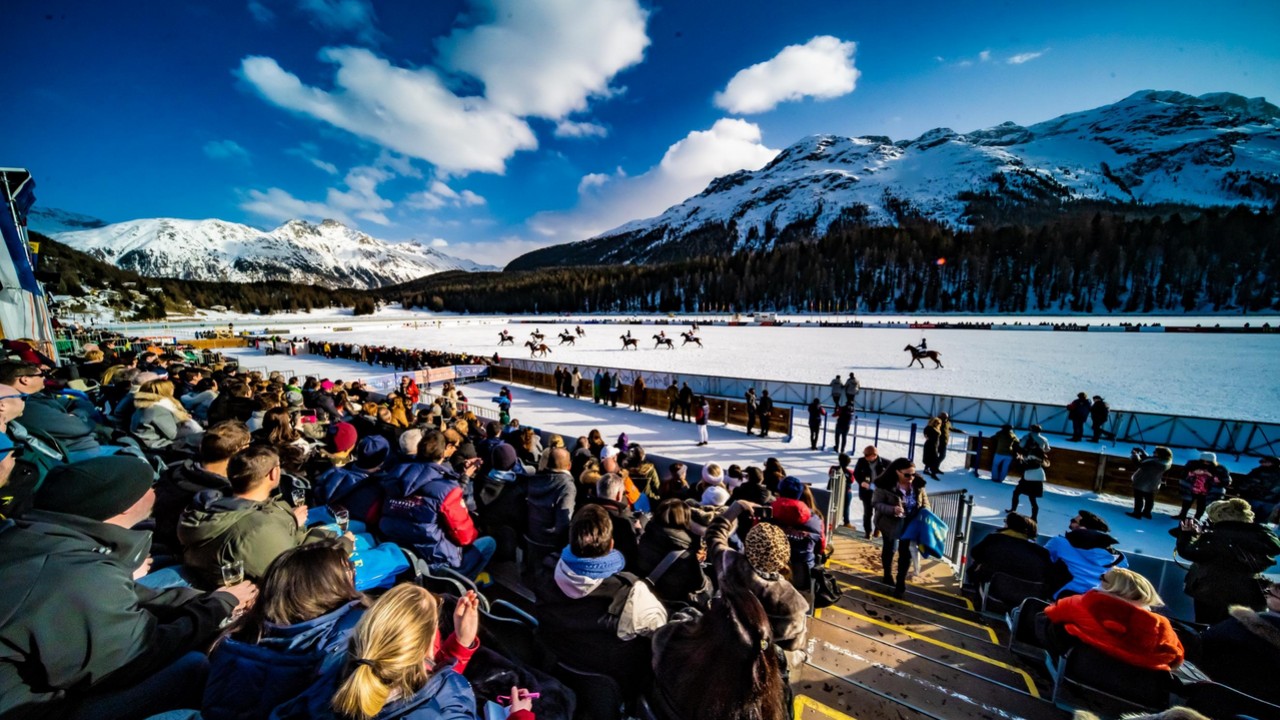
The private airport at Samedan fills first. By the time the ponies’ step onto the frozen surface of Lake St. Moritz, the crowd of more than 25,000 has arranged itself into a tableau of extraordinary self-consciousness — champagne flutes paused mid-air, Birkins brushing against Mackage puffers, calls from the Zurich family office unanswered.
The Snow Polo World Cup St. Moritz has been running since 1985, when Swiss hotelier Reto Gaudenzi solved the problem of polo on ice with inflatable balls and rubber-insert studded horseshoes. What emerged was the only high-goal tournament played on snow on earth, now in its 41st edition. Some 4,000 tonnes of infrastructure, including more than 100 acclimatised polo ponies, appears for a single weekend and is gone the next, leaving the frozen lake to resume its ordinary silence.
Polo Ponies Among 2,000-Year-Old Tombs
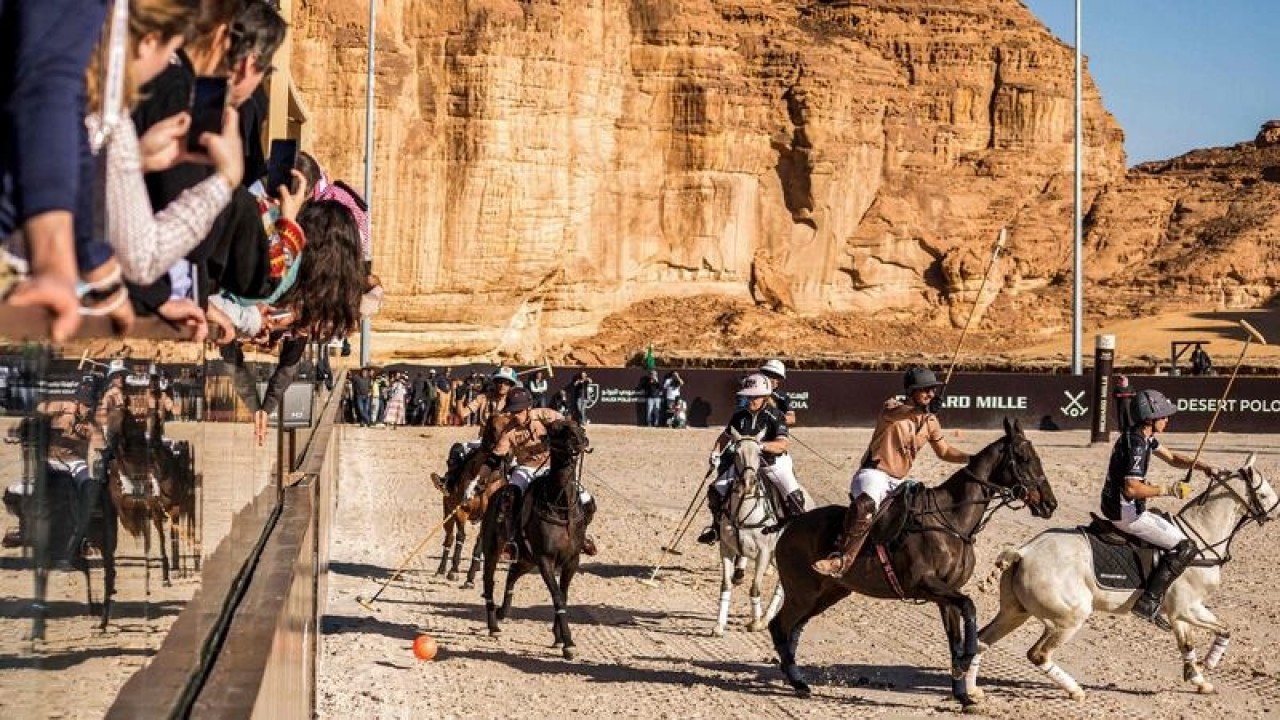
From a frozen Swiss lake to a desert canyon in north-west Saudi Arabia — the meridian crosses time zones and, more significantly, several thousand years of history. The AlUla Desert Polo, held at the purpose-built Mohammed Yousuf Naghi Equestrian Village, is the world's first and only polo tournament staged in a desert environment, organised by the Royal Commission for AlUla in partnership with the Saudi Polo Federation since 2020.
No other stop on this itinerary, places contemporary sport inside an active archaeological landscape of comparable magnitude. The arena sits in close proximity to Hegra, Saudi Arabia's first UNESCO World Heritage Site — a Nabataean city of more than 110 intricately carved sandstone tombs built in the first century AD. The rock faces of Jabal Ikmah carry petroglyphs of horses and ostriches alongside inscriptions in Dadanitic, Lihyanite and Nabataean. Polo ponies thunder across sand within eyeshot of carvings confirming this ground has known horses for two millennia before the modern game was codified.
The 2025 edition drew Adolfo Cambiaso — widely considered the greatest polo player of all time — competing alongside his daughter Mia Cambiaso and son Adolfo Poroto Cambiaso. Three generations of one family coalescing in a single desert tournament speaks to AlUla's rapidly growing stature on the global circuit.\\
The Sport As Royal Institution
Arabic coffee gives way to Pimm's. The desert canyon gives way to 53 hectares of Windsor Great Park turf, where the English summer has conducted its annual performance of power, lineage and linen trousers since 1955. The Guards Polo Club, founded at Smiths Lawn on the initiative of Prince Philip, Duke of Edinburgh, now operates under the presidency of King Charles III — who won the club's most prestigious prize on his own team in 1986. The continuity across three reigns is unbroken.
The centrepiece of a season hosting more than 500 matches is the 22-goal Queen's Cup, established in 1960. The 2025 final was won by Park Place, led by Hilario Ulloa — 12 to 10 over La Dolfina Marqués de Riscal, with King Charles III watching from the royal enclosure. The dominant bloodline at this level remains the Argentine polo pony — bred from Thoroughbred and Criollo crossings on the Pampas. The British game now depends on horses bred in the country that learnt the sport from England in the first place. The finest animals change hands at between US$400,000 (AED1,469,000) and US$550,000 (AED2,020,000).
The Game Free To Watch From The Sand
The same man who put polo on a frozen Swiss lake put it on a Dubai shoreline. Reto Gaudenzi invented beach polo in Dubai in 2004 and his son Tito Gaudenzi co-founded the Beach Polo World Cup Miami Beach the following year. The premise connects Stop One and Stop Four across the full arc of this itinerary: put polo somewhere it has never been before.
The Miami Beach edition, the world's largest beach polo event, takes place each November on the sands of South Beach. Eight international teams, more than 120 horses, over 12,000 visitors — the ball corralled at all times by four-foot sideboards, three players per side, the pace relentless. The crucial distinction from every other stop: admission is free. This is polo without a private helicopter or an invitation, watched from a beach towel alongside the Atlantic.
A Runway Becomes A Polo Field
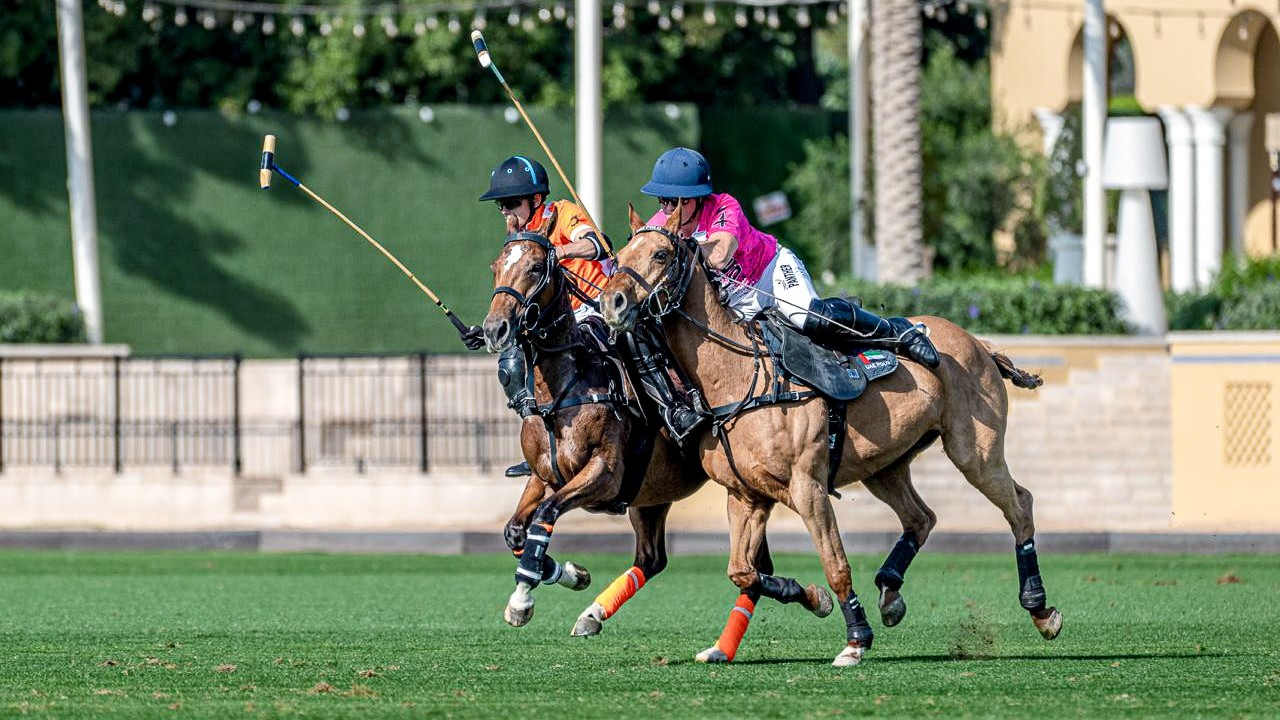
The season moves to August, to the Swiss Alps, to a polo field laid on an airport runway at 1,000 metres. The Gstaad-Saanenland Airport shares its grass strip with small aircraft for most of the year. For four days it becomes the stage for the Polo Gold Cup Gstaad — the highest summer tournament in the world and the most deliberately discreet stop on the circuit.
Four 14-goal teams. Some 6,000 guests over three days. The 2025 final was won by Gstaad Palace, defeating Albinati Aeronautics 7 to 4. MVP Martín Podestá scored four goals in the decider while Best Playing Pony honours went to Doma Simoca, a 9YO grey mare bred by La Irenita. Team captain Markus Graeff lifted the trophy at 73 years of age — a detail sitting alongside the Marchioness of Milford Haven competing at 64 in the AlUla desert, dismantling any assumption that polo belongs to the young. On a Friday before competition begins, players parade on horseback through the Gstaad promenade, threading between luxury boutiques in a procession that exists nowhere else on the calendar.
No Helmets, No Referee, No Rules
At 3,700 metres above sea level — 1,844 metres higher than the frozen lake at St. Moritz — the Shandur Polo Festival takes place each June or July at the world's highest polo ground, on a mountain plateau in Chitral, Khyber Pakhtunkhwa province, Pakistan. For the remaining 362 days of the year, the ground is grazing land for yaks and donkeys.
No rules. No helmets. No referees. No mallet straps. Disputes are resolved by local elders. Six players per side ride locally bred mountain ponies — hired from village owners and returned to their ordinary working lives after the festival. The 2025 final saw Team Chitral defeat Gilgit-Baltistan 9 to 8 in extra time, with both teams reduced to three players due to horse injuries. Shandur sits where the Hindu Kush, the Himalayas and the Karakoram converge. This is polo before it acquired a handicap system, a dress code or a title sponsor — the game belonging entirely to the communities who have played it for centuries.
The 40-Goal Team And A 31-Year Dynasty
The journey ends at the Campo Argentino de Polo in Palermo, Buenos Aires — home since 1928 to the Argentine Polo Open Championship. The championship has been running since 1893. It is the only venue on this circuit where the early rounds are free and where the crowd of 30,000 arriving for the December final knows every player's career record, every pony's bloodline, and exactly what is at stake.
The 2025 final produced the rarest thing in sport: a 40-goal team. La Natividad La Dolfina — Adolfo Cambiaso (10 goals), Adolfo Poroto Cambiaso (10 goals), Camilo Castagnola (10 goals) and Bartolomé Castagnola (10 goals) — carried the maximum possible combined handicap and won 17 to 13 against Ellerstina Indios Chapaleufú Vista to claim the Triple Crown. In the opposing lineup, Facundo Pieres appeared in his 16th Palermo final; his brother Gonzalo Pieres in his 14th.
Adolfo Cambiaso won his first Argentine Open in 1994 at 19 years of age. He won the 2025 edition at 50, alongside a son whose birth he attended by leaving an Argentine Open qualifier mid-match. The span between first victory and latest: 31 years. In the 2021 Palermo final, 50 of the 92 horses played, shared the bloodline of one stallion, Sportivo, acquired for US$5,800 at the San Isidro races in 1998. The genetic legacy of a single horse defined more than half the animals in the world's greatest polo final.
The Goalpost Width That Has Never Changed
Seven stops. Seven surfaces. Seven truths. Ice reveals polo as theatre. Desert reveals it as archaeology. Royal grass reveals it as institution. Sand reveals it as democracy. Alpine grass reveals it as precision. Altitude reveals it as origin. Buenos Aires reveals it as destiny.
Shah Abbas the Great built a polo ground in Isfahan in the 16th century with goalposts the same distance apart as those on Campo Field 1 in December 2025. The surfaces have multiplied. The horses have been cloned and crossbred and conditioned at altitude. But at every stop, without exception, someone dismounts and fills in a divot with their hands — the one universal ritual the sport demands of every surface, every culture and every person standing close enough to the field. The polo meridian completes its year. The frozen lake will fill again in January.